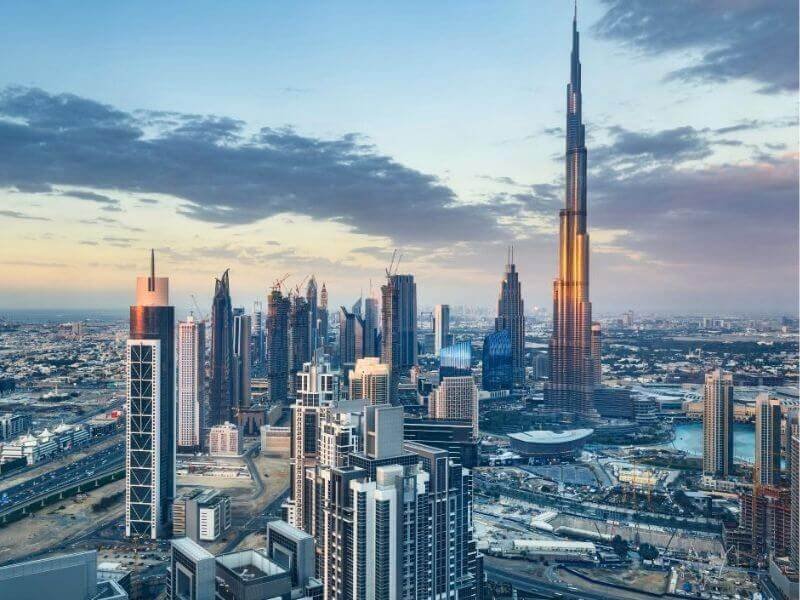
Dubai real estate's 2025 performance of €171.7 billion and its prospects for 2026
Comprehensive market analysis, areas of high performance, and projection for 2026
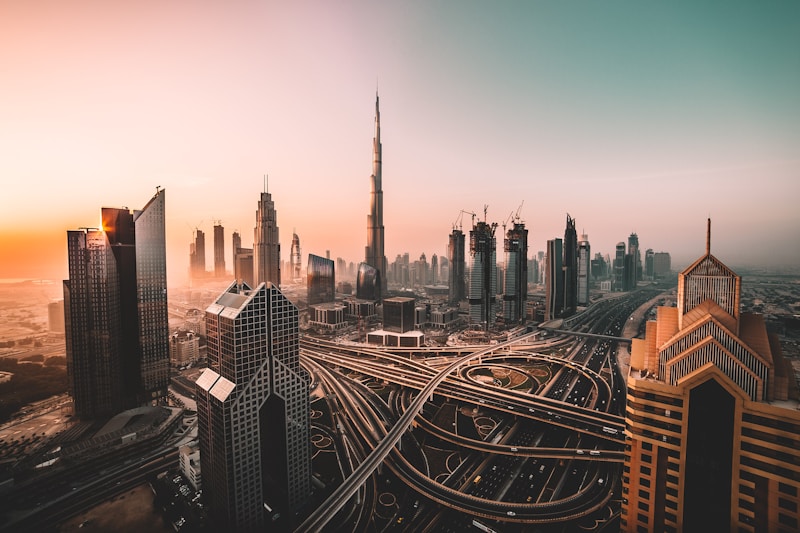
With 215,700 transactions totaling AED 686.8 billion (€171.7 billion), Dubai's real estate industry ended 2025 with record-breaking results. All types of real estate are included in the statistics, including structures, land plots, commercial, and residential properties, with residential properties making up the largest portion. In December alone, 18,587 transactions of AED 63.1 billion (€15.8 billion) were completed, a 46.4% increase in value over the previous year. For the fifth year in a running, the emirate's real estate industry has experienced record-breaking growth.
An analysis of 2025 performance
Throughout 2025, Dubai's real estate market performed well, with purchasers favoring off-plan constructions in particular. Nearly 70% of all sales involved pre-construction properties, as investors benefited from flexible payment plans and the possibility of capital growth during development stages.
While villa sales fetched far higher average prices, apartments continued to be the most transacted property type, making up the majority of agreements. With transaction values rising more than 40% year over year, the commercial sector showed remarkable momentum and reflected Dubai's growing economic environment.
In terms of luxury, the market kept breaking milestones. AED 550 million (€137.5 million) penthouse at Bugatti Residences in Business Bay was the year's most notable purchase, demonstrating Dubai's allure to ultra-high-net-worth buyers looking for showpiece assets.
High-performing regions
With a transaction value of around AED 38 billion (€9.6 billion), Business Bay was Dubai's best-performing district in 2025. Investors and end users continued to be drawn to the central business district because of its riverfront position and mix of residential and commercial structures.
Palm Jumeirah continued to lead the premium market, while Jumeirah Village Circle was the second most active location. The Burj Khalifa neighborhood, Meydan, and Airport City were further high-performing areas that benefited from well-established communities and robust infrastructure connectivity.
In comparison to other worldwide cities, real estate costs were still reasonably affordable. Villas sold for an average of AED 3.1 million (€775,000) by year's end, compared to an average of AED 1.4 million (€350,000) for apartments.
Dynamics of supply and demand
Developers introduced 177,624 new units in 2025, up 6.1% from 167,408 the year before, while the market delivered 42,784 properties in 2025, up 45% from 29,392 units in 2024.
Important Drivers of Demand:
Over 4 million people live there (with an additional 208,000 in 2025).
18.7 million overnight tourists arrived (up 9% YoY).
Over 250,000 Golden Visas have been issued since 2021.
The transfer of about 120,000 units is planned for 2026.
Regulations that encourage foreign investment have greatly supported the ongoing demand. The Golden Visa program, which has issued more than 250,000 since 2021, has established institutional basis for ongoing transaction development, and the UAE's ownership restrictions for foreign buyers allow 100% freehold title in defined zones. Investment accessibility and holding strategies are strongly impacted by these restrictions, which differentiate between freehold lands where buyers hold full title and leasehold arrangements.
Evolution of the market
A changing market dynamic is shown by industry analysis. "Momentum drove decisions in 2025, but buyers will operate with far more logic and discipline in 2026," said Firas Al Msaddi, CEO of fête Properties. Buyers are progressively placing a higher value on connection, project fundamentals, developer execution track records, and true lifestyle value than on speculative momentum, according to the firm's analysis utilizing DXBInteract data.
Throughout the emirate, a two-tiered landscape is emerging:
Prime Areas (Modest/Stable Growth):
Downtown Dubai
Well-established Emaar communities
High-Supply Areas (Potential Stabilization) at Dubai Marina:
About 35,000 residences are anticipated in Jumeirah Village Circle (about 10% of Dubai's total projected supply).
The role of connectivity in pricing
Property values are increasingly being influenced by metro connectivity. As transportation linkages increase accessibility, communities that will benefit from the impending Blue Line expansion—such as Dubai Creek Harbor, Festival City, and parts of Dubai Silicon Oasis and International City—are seeing a surge in buyer interest.
In the meanwhile, lifestyle-oriented, walkable projects like Bluewaters Island, Central Park at City Walk, and City Walk are fetching premium positioning. Integrated shopping, well-considered design, and human-scale planning that promotes pedestrian movement rather than reliance on cars are all advantages of these master-planned communities.
Superior performance
Ultra-prime locations are still exhibiting structural resilience, according to industry observers. These villa neighborhoods exhibit the lowest tolerance for discounts and the highest resale velocity:
Jumeirah Bay Island, Palm Jumeirah, Al Wasl, Dubai Hills Estate, Mohammed Bin Rashid City, Emirates Hills
Michael Kiesling handles commercial and real estate issues for companies, business owners, property owners, developers, and contractors.
Landlord-tenant issues, construction claims, property title and easement disputes, contract disputes, nondisclosure and fraud claims, liens, and eminent-domain matters are among the areas in which he has expertise.
Momentum of the business sector
With office, logistics, and mixed-use buildings benefiting from ongoing economic growth, infrastructural investment, and growing corporate presence, the commercial real estate industry continued to grow rapidly. Long-term demand is strengthened by this in a variety of asset types outside of residential real estate.
Economic background and factors driving growth
Growing populations continue to be a crucial factor in market absorption. The head of research at Knight Frank, Faisal Durrani, claims that if population growth continues to exceed 5% per year, Dubai will be able to accommodate the additional housing stock. This base has been reinforced by the emirate's economic diversification, with financial services now contributing more to GDP growth than construction.
Abu Dhabi's regional performance is improving
By November 2025, home sale prices in Abu Dhabi had increased by around 30%, demonstrating the market's comparable strength. As analysts point out the capital's competitive location, infrastructure development, and relatively conservative supply pipeline in contrast to Dubai's more aggressive expansion, the capital is gaining more and more attention.
Trends in the rental market
Rent growth slowed to about 6% year over year in November 2025, down from 14% in January, indicating a softening of the rental market from earlier high. As new inventory enters the market throughout 2026, industry watchers anticipate that rents will either plateau or exhibit mild low-single-digit growth. After several years of remarkable development, this stabilization and a slowdown in price appreciation from the 19.8% annual rate noted in December 2025 suggest that the market is reaching equilibrium.
2026 prospects
The market's development is a reflection of the economy as a whole. Through a variety of avenues, including employment in financial services, infrastructure for tourism, expansion of logistics, and growth in the technology sector, Dubai's diverse economy today sustains demand for real estate. Real estate values are better supported over the long run by this multi-pillar structure.
As 2026 goes on, industry watchers stress that Dubai's real estate market is no more a single, cohesive unit. It is now crucial to take into account location-specific analysis, comprehend supply pipelines by micro-market, analyze developer quality, and evaluate connectivity infrastructure. A more complex market where performance differences are driven by fundamentals has replaced the period of consistent price appreciation across all sectors.
END.