UAE Payment Landscape Shifts as Stablecoins and Digital Wallets Expand
Cards remain dominant, but digital wallets, BNPL, instant payments and emerging stablecoin solutions are creating more choices for UAE consumers and businesses
The UAE's payment landscape is expanding beyond traditional card transactions as digital wallets, buy now, pay later services, instant payments and emerging stablecoin solutions gain greater attention.
Industry executives say cards continue to account for a large share of consumer payments, but the number of alternatives available to shoppers and merchants has increased significantly in recent years.
The development comes as businesses across the UAE invest in payment technology designed to support digital commerce and transactions across multiple markets.
Al-Futtaim expands digital payment infrastructure
Al-Futtaim has partnered with global payments technology company Juspay to develop a unified payment orchestration system across its brands and markets.
The partnership is intended to simplify payment management across different businesses while supporting local payment methods, fraud management, tokenisation and other digital payment capabilities. Al-Futtaim said the rollout began in September 2026.
Paul Carey, Al-Futtaim's executive vice-president for cards, payments and fintech, said the payments environment has changed considerably over the past five years.
Consumers now have access to options ranging from BNPL and digital wallets to direct bank payments, while businesses are dealing with increasingly complex payment requirements across different countries.
Al-Futtaim said between 30% and 50% of spending across its businesses is now conducted online, although the proportion varies between individual businesses. Carey also noted that crypto and stablecoins are beginning to enter the payments landscape.
Stablecoins expected to gain a larger role
The potential growth of stablecoins is particularly significant in cross-border business payments.
Research commissioned by Nium and conducted by Celent found that Middle Eastern banks expect stablecoins to account for an average of 10.4% of outgoing cross-border business payment volumes by 2035, compared with 1.6% in 2025.
The research also projects growth in other emerging forms of digital money. Tokenised deposits are expected to increase from 1.2% of payment volumes in 2025 to 6.2% by 2035, while central bank digital currencies are projected to rise from 0.6% to 4.1%.
Combined, stablecoins, tokenised deposits and CBDCs could account for 20.7% of payment volumes by 2035, compared with 3.4% in 2025, according to the research.
The study also indicates that traditional cross-border payment infrastructure will remain important, although banks expect the share of payment volumes handled through Swift to decline from 77.2% in 2025 to 55% by 2035.
UAE sees early stablecoin payment activity
The shift is not limited to forecasts.
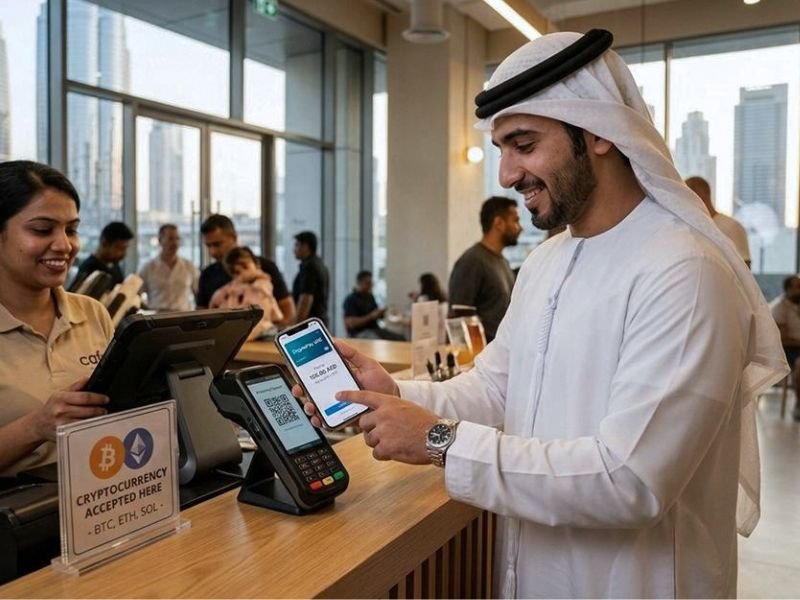
In September 2026, Network International announced what it described as the UAE's first in-store pilot for AED-backed stablecoin payments. The pilot allows customers using supported wallets to make payments through existing point-of-sale terminals at selected merchants.
The pilot included a Marks & Spencer location at Dubai Festival City and a Lulu Hypermarket at Khalidiyah Mall in Abu Dhabi.
The development provides an early example of how regulated stablecoin technology could potentially connect digital assets with everyday retail payments in the UAE.
Digital payments create new opportunities and challenges
The expansion of payment options is also increasing the complexity faced by merchants operating across borders.
Juspay's Nakul Kothari said growing cross-border commerce is contributing to a more complicated payments environment, where businesses need to support different payment methods and markets.
At the same time, adoption of newer payment technologies remains at an early stage. Nium and Celent's research found that 53% of surveyed banks were struggling to establish a business case for emerging payment technologies, while half said the technology was not yet mature enough.
For the UAE, the combination of expanding digital commerce, local payment infrastructure and growing interest in stablecoins points to a payments market with an increasing number of options.
Cards remain an important part of the payment ecosystem, but digital wallets, instant payments, BNPL and emerging blockchain-based payment solutions are becoming increasingly relevant to the future of commerce in the country.
END.